Showing posts with label Gallery 2-8. Show all posts

Saturday, January 3, 2015

daily routine

by Misik Kim

Communication
Since I started to have sewing play in a nursing home, I've thought a lot about my life.
While I was sewing with them I was so sad.
Because the pieces of their mind were disappearing little by little.
I was thinking about how I lived on, how to live.
When I did this challenge, I thought, do my work like daily routine, live and communicate with many people in work.
Maybe this is something I want while I'm alive.


Tuesday, December 30, 2014

Witches' Brew


I have been working with cauldrons and skillets as sources of designs for some quilts which I am making for an exhibition in Autumn 2015 in the UK. The letter Tet has a clear cauldron shape, so I decided to investigate some further connotations.

A cauldron is a large metal cooking pot, also used for boiling, often made of cast iron or copper. They often have three legs, which allows good air flow; sometimes they have a hanger. They are not used now in modern society, but it was a main cooking tool for many centuries, and in a variety of societies.  The association with cooking means that the produce of the cauldron gives sustenance to people.  We couldn’t live without food.  Eating allows us to live, and therefore to achieve our potential.


There are ancient stories that talk about cauldrons of great abundance, bottomless, capable of feeding an army.

Cauldrons, as a cliché, are also associated with witches.  Witches have a bad press, but I believe they were women trying to develop medicines and healing potions; as they were different from the common and accepted folk, they were feared and persecuted.

In Neo-Paganism, cauldrons, with their three legs, are sometimes meant to represent the Goddess in her three states: Maiden, Mother and Crone. They are also meant to represent the three main stages of life:  birth, life and death. The shape of the cauldron represents the womb of Mother Nature.

Skillets have long handles.  Some of the ones I studied have relief inscriptions on the handles. The text can be simply the name of the maker, but other times they are moral sayings, such as “Love thy Neighbour”.


My piece shows a large Tet-shaped cauldron, on a fire, cooking mankind’s potential, and the ‘steam’ coming from it writes positive statements. They are, from left to right:  YOU ARE ALIVE; THINK BIG; A WORLD OF POSSIBILITIES;  REACH FULL POTENTIAL; DREAM THE DREAM.  A few other cauldrons and skillets, each with three legs, and one with a hanger, complete the picture.


18” by 18”; hand-dyed cotton, fused appliqué, machine quilting.

Saturday, December 27, 2014

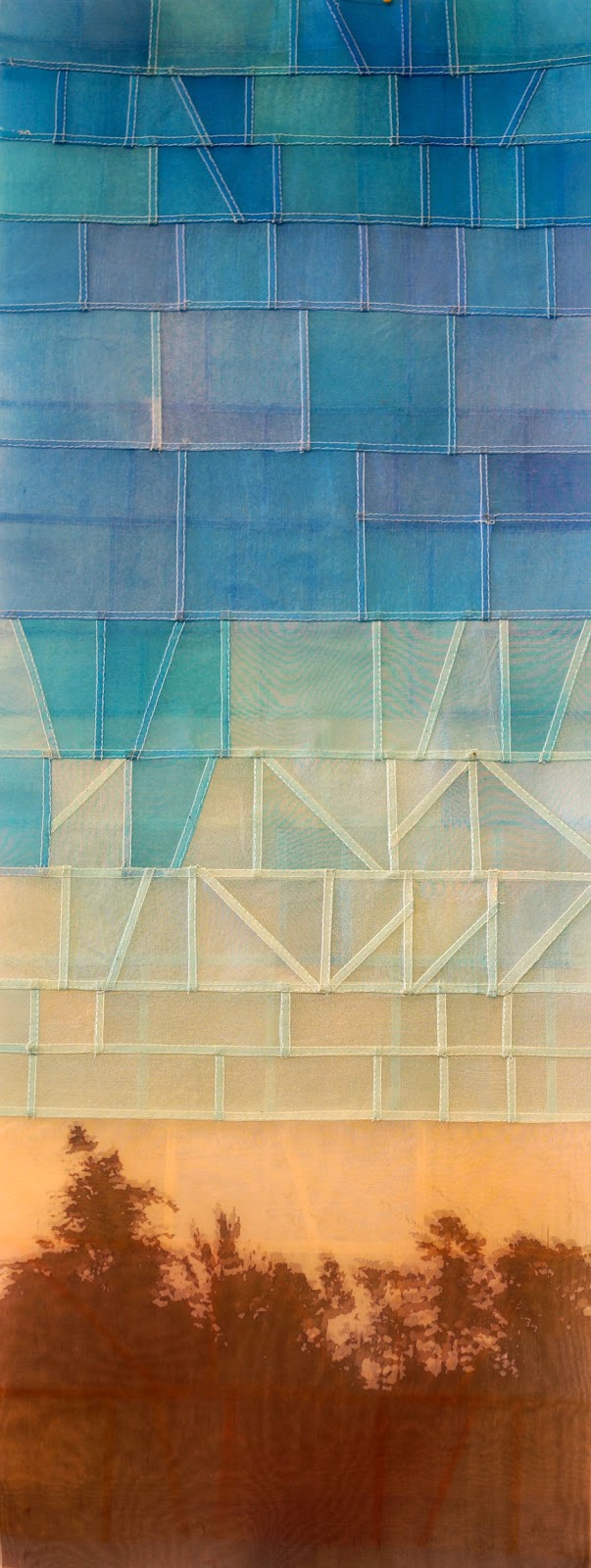
After Life

After Life ©2014, 9" x 27"
Thanks for this challenge, Betty.  It had the wheels turning despite all of the hubbub of holidays, which, in retrospect, may be the genesis of some of this.  I embraced the phrase "hidden potential" and tried to work with that idea.  Suddenly everything I considered had hidden potential.  My piles of fabric, the fruit on my trees, my children, an airplane trip…  The one thing I kept coming back to was the sunrise on a new day.  Everyday is filled with opportunity and promise as the sun rises over the trees (or sand or snow).  What can happen in a day?  Almost anything.  We work to have control over our path in life and yet, it can all change in a matter of moments.  It can be fabulous, it can be disaster, and yet every morning I rise and see the sun and I am filled with optimism and hope.  For myself, for my family and friends, for the whole world.  So much potential.

After Life evolved from the idea of a sunrise, to take on greater personal meaning.  I looked through my photos of sunrises, from mountain tops, on beaches, and settled on a photo of the sunrise I took the morning my father had passed away.  As I left his side and wandered to the parking lot, the sun was just coming up over the trees.  It was Sunday morning.  My father was a minister and rose early, often before sun up, on Sundays to prepare for church.  How fitting.  And what of the hidden potential of an afterlife?  What is after life?

After Life is made from hand-painted silk organza.  There are 3 layers of pojagi like patchwork, the sunrise, in yellows and oranges, is only on the bottom layer.  The tree line is a photo transfer of my image.  I was pleased to perfect the tiny French-type seams - something new.  The sewing is both machine and handwork.

Backlit (may favorite way to view pojagi), the piece shares another glimpse of hidden potential.

After Life (backlit)

Fiberwonk Recalls ENIAC

My father was a taciturn statistician.  A time and motion expert in the US military.  I recall the wonderment in my father's voice when he described his trip upon returning from a secret destination.  Somewhere in the US there was a  huge cavern under a mountain.  We knew that.  We didn't know where.  He would tell us about huge machines housed there that could figure out everything.  He lit our imaginations telling us how wonderful our world would be when we were adults and had kids of our own.

Now we know a bit more.  Not the details. But we do know he was talking about the late 1940's first Electronic Numerical Integrator and Computer financed by the US Army.

We can all relate to how incredible the prospects must have seemed (and still do) at the potential for artificial intelligence.  As interesting is the potential in the stories and ideas told to small children by their parents.  Those tales generated such curiosity in us, his four children, that each studied mathematics and three went on to life-long careers.  Fortunately he lived to know that.

As for potential:  I really do think that words spoken to small children REALLY do make a difference.  Yes, actions too.  But those stories that are replayed in little people's heads are very powerful.

Fiberwonk Recalls ENIAC
Commercial cottons, found objects.  18" x 18"

Intercellular

When my Dad was staying with us, I took him to the Friday night fractal show at the local planetarium, mostly to humor him.  Well, it was a mind blowing experience that has influenced my work ever since.
The thought of the same patterns repeating themselves through infinite scale changes is just amazing, in Intercellular I have tried to capture the experience of virtually zooming through layers of design.

Intercellular

33x27, 2014

The first layer was my favorite, silk painting- I tried to capture tiny dots that would fade in and out of focus.
I quilted it, and painted between the lines with red and orange fabric paint to emphasize the next tier of the design.
The green structure is painted Evolon, which is appliquéd over the quilted base- followed by the final purple macro area which is stuffed with felt.

 This seemed to be an appropriate response to the challenge- what has more potential for change than an undifferentiated growing organism?

Artistic potential


What interests me is seeing how my young grandchildren, Ruby, Marli and Araluen approach their drawing activities. I give them the pencils, pens or crayons and don't impose criteria usually. However for this exercise I asked the older two to draw within the assigned space on the white fabric. They also kindly gave me permission to use their work in my work. It is a privilege to watch my grandchildren realise their potential. Will their artistic potential blossom further in the years to come?
Artistic potential- detail
9 3/4"w x 26 1/4" [25cm w x 66.5cm]
Materials: Cotton fabric, fabric crayons, paint and pens, batting, thread.
Techniques: Drawing, colouring, machine quilting. 


Biology, Puzzles, and the Hidden Potential of Online Gamers


For 15 years, Scientists at the University of Washington's Biochemistry department had been struggling to fully understand the enzyme structure for viruses such as HIV/AIDS. But even with the help of powerful computers, they were unable to create a working model.

Finally in 2011, they decided to take a new approach. Dr. Firas Khatib created a video game called Fold it.  The game requires players to figure out a protein structure, given certain parameters, tools and information that the scientists had figured out thus far. They put Fold it on line and challenged gamers to find the solution, hoping that human brains could do what computers could not: think intuitively and creatively in 3 dimensions. The puzzle was available on line for free, for a period of 3 weeks. 

The idea paid off. Gamers figured out the structure in just 10 days. 

In fact the gamers' solution allowed scientists to refine the model for a protein enzyme structure, which has contributed to research in anti-viral drug therapy, causes and cures for cancer and immune deficiencies and environmental work on bio-fuels.

“The ingenuity of game players,” Khatib said, “is a formidable force that, if properly directed, can be used to solve a wide range of scientific problems."
I love the idea of looking outside one's own circle of influence to tap into new ideas (new viewpoints, if you will). Serious research scientists are always looking for new sources of information and ways to interpret data. 

Until the invention of the internet, there was no way to access such a large, diverse group of "thinkers" and ask them to work simultaneously on a single problem. Now we have a world full of strategists, puzzle solvers and curious minds, all with the potential to become virtual research assistants (or maybe test subjects). Who knows where the next break through will come from?


(detail)
Title: Control
Technical Details: Finished size 18" x 18"
Depicts a close up view of an Xbox game controller
Hand dyed cotton and batik fabrics, cut and layered via raw-edge applique, sewn together using hand-guided machine stitching, with rayon and polyester thread


Carving Mother Nature


Carving Mother Nature

There is a definite hierarchy of fabric in my stash. Most favored are the Shibori and Hand-Dyed. Commercial fabrics aren’t even a close second. At the bottom of the heap are Fat Quarters. I sometimes wonder why I ever bought them.

But I must’ve had a reason, right? I must’ve seen something I liked or wanted. Some potential. And so began my initial idea for Betty’s Tet challenge: unleash the hidden potential in my least favored fabrics. 

I figured the only way to have a successful quilt with undesirable fabrics would be to choose a desirable topic. I’ve always wanted to do a canyon quilt and I love all things water-related; it seemed logical to combine the two. Which, interestingly, represents another nuance of hidden potential.

Think of a water drop: clear, small, amorphous. No one’s afraid of a drop of water. And yet, it is the source of life. 50% to 75% of the human body is comprised of water. 3-4 days without water and a person would perish.

If asked which were stronger, water or rock, I imagine most would say rock. But drops of water can create rivers and currents and waves strong enough to carve rocks. In its seemingly innocuous, liquid clarity, a drop of water holds limitless power.

 I used the hidden potential of both water and fabric to create “Carving Mother Nature” 18” W x 27” H. Made exclusively of commercial cotton fabrics from my stash of strips, scraps and lowly fat quarters. The words water source of life are quilted into the foreground.


Water Source of Life

Out of Thin Air

by Lin Hsin-Chen

I have always feared learning unfamiliar languages. When I saw the ninth letter of the Hebrew alphabet ‘tet’ for the first time, I realized that I have to make change and be brave to accept characters other than Chinese. Feeling helpless, I did a sketch freely to relieve my anxiety and increase confidence for a while. And then I try to weave joy out of thin air. Thus, the unknown flower is born.

After careful consideration, I decided to extend the flower based on the fundamental element of freedom in hopes of having a good art performance and experimenting on new creating techniques. During the creative process, I sketched spontaneously and followed my heart to cut fabrics with scissors. I sewed them directly without making any modifications. Besides, in order to pursue my original creative concept of freedom, I stop myself from changing the fabrics. I only choose once for every piece of fabric I use in the work. I know that protecting ourselves is a human instinct. Fearing of language learning is also one of them. However, art helps me to accept Hebrew language and arouses my creative energy to seize every possible opportunity.


 This piece, Out of Thin Air, depicts a flower reborn from complex inner fears. It is joyful, confident and creative. It is also a meaningful self-learning! It’s wonderful that Betty brought this challenge topic to us. I’ve learned so much from it. It has made me not only better understand myself and accept the learning concept of starting from scratch, but also complete an interesting work! Thanks for that! It is the last piece I made in 2014. “Out of Thin Air” brings me expectation for 2015. I wish you all a Happy New Year!

Materials: commercial cottons
Techniques: hand pieced, hand appliqué, hand quilted
Size: 18” x 27”